Home › Fuel Modification Zones
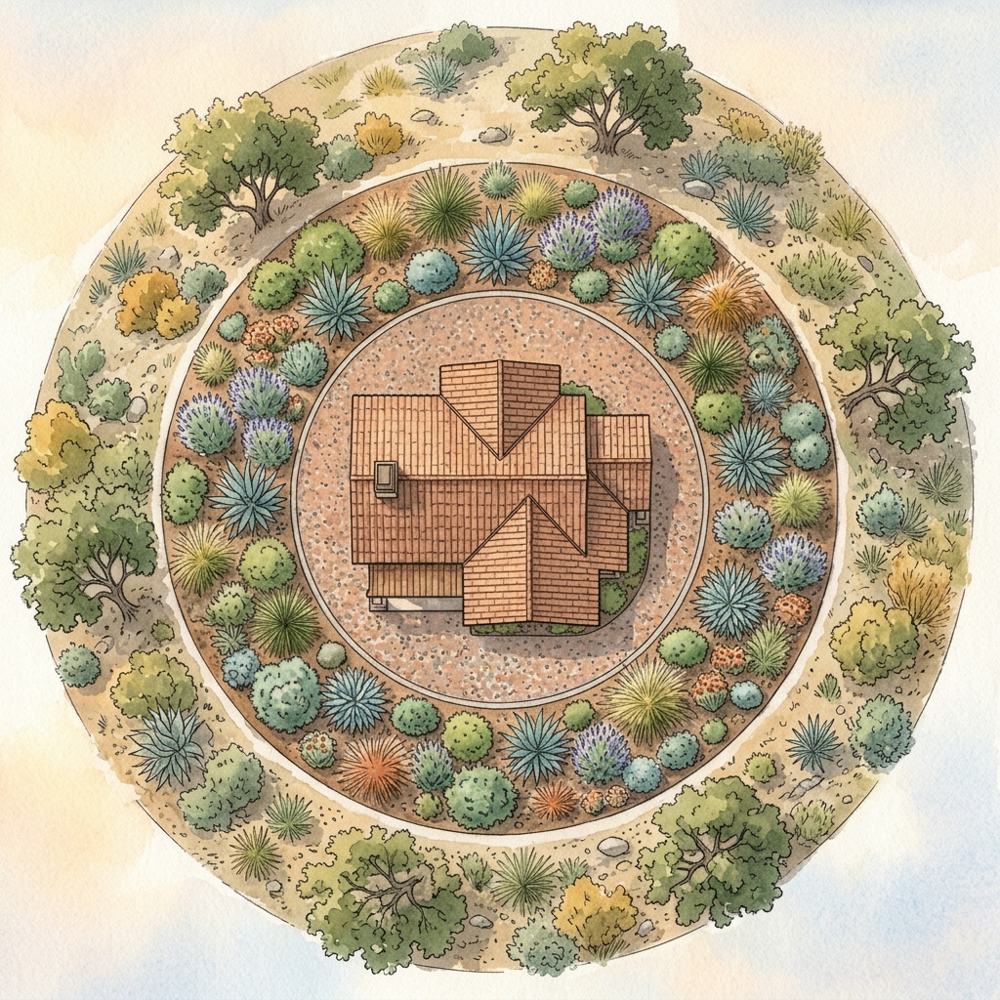
How the zones fit together
| Zone | Distance | Local band | Its job |
|---|---|---|---|
| 0 | 0–5 ft | Setback | Hard, ember-resistant. Nothing combustible. |
| 1 | 5–30 ft | Irrigated | Low plants in islands; trees limbed; no dead material. |
| 2 | 30–100 ft | Thinning | Thinned natives, mown grass, spacing. |
| 3 | 100–200 ft | Outer buffer | Some agencies only (LA, Ventura): no dead brush, no ladders. |
Distances are minimums, not targets. Slope and wind can justify more. The goal is managed vegetation, not bare soil.
Names differ by agency. Los Angeles County Fire, for example, uses Zones A, B and C rather than 0 to 3: Zone A runs from the structure to 30 ft, Zone B to 100 ft, and Zone C up to 200 ft depending on site conditions. Always use your agency’s own labels on plans.
Two layers of rules
State defensible space law (Public Resources Code 4291, enforced by CAL FIRE) sets the baseline. Many cities and counties add a local Fuel Modification Plan reviewed by the local fire authority. Find your agency; it always has the last word.
How a home ignites
- Embers travel a mile or more ahead of a fire and land in gutters, vents and mulch.
- Direct flame from shrubs, woodpiles or fences touching the house.
- Radiant heat can crack glass and ignite siding without contact. Distance is the main defense.
Next: Zone 0, the first five feet · spacing rules.
Fire-safe still needs a water budget. Validate your hydrozones, WUCOLS plant ratings and MAWA water budget, and get permit-ready compliance documents, at MWELO.com. For fuel-mod plant choices, see the MWELO fuel mod guide.